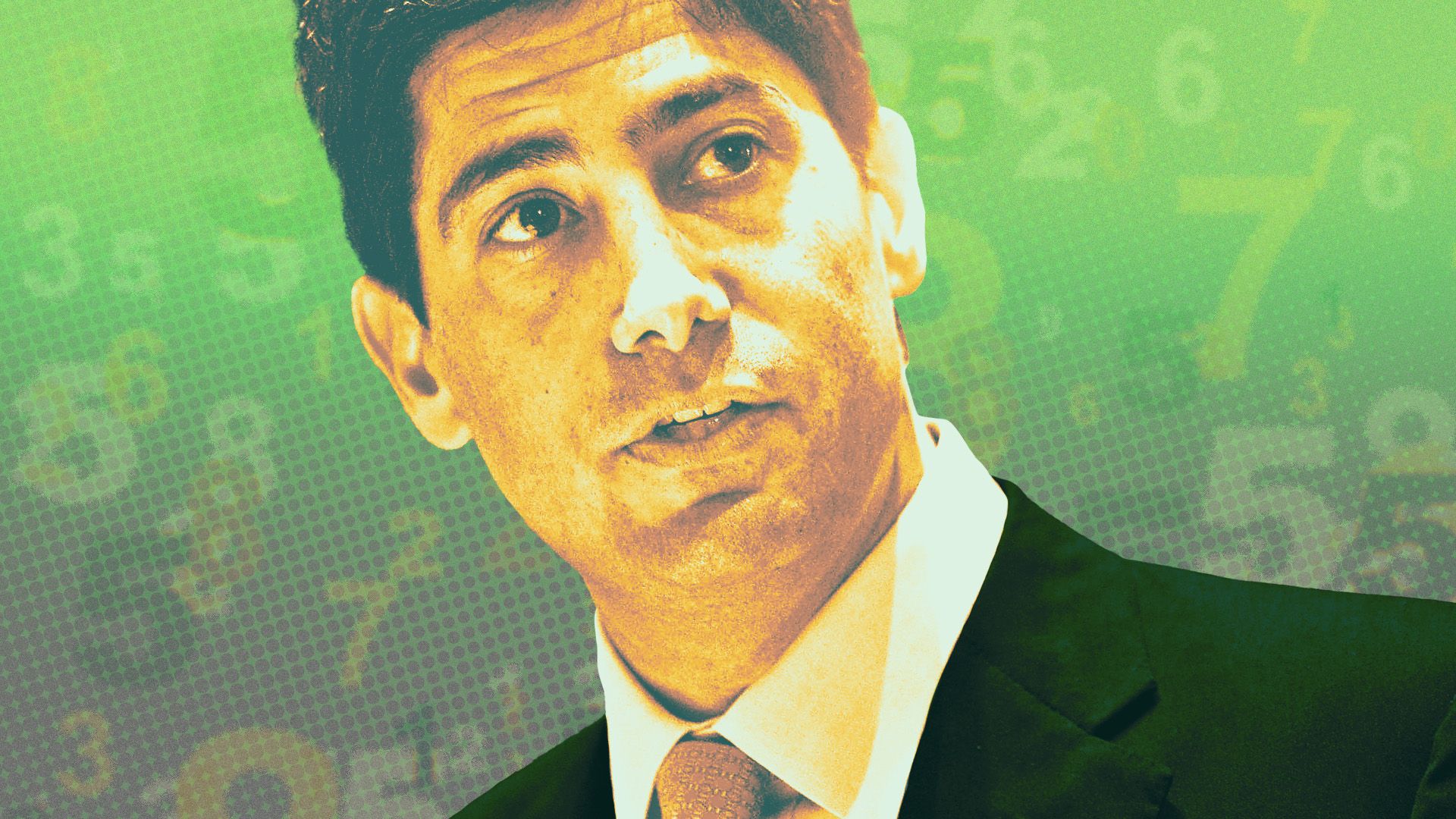
Why Wall Street wants to talk about Kevin Warsh
Tired: talking about the price of oil. Wired: talking about Kevin Warsh.
The new Federal Reserve chairman is the topic du jour among market analysts and investors trying to parse his every move — as well as his suit.Why it matters: The direction of U.S. monetary policy is crucial to markets, which behave very differently based on whether investors believe interest rates are going up or down or will be holding steady.
The big picture: A new Fed leader is always going to be heavily scrutinized by Wall Street, but Warsh has perhaps drawn even more chatter because he's made it clear that he'll be handling the job differently than his modern-day predecessors.
He's expressly said he wants to give less guidance on what the Federal Reserve plans to do in the future. And without a firm understanding of the Fed's direction, market watchers are left to more tea leaf reading and chatter.Warsh is effectively a blank slate for investors to project their theories onto — a subject for more drama and conversation.Zoom out: Going into his first press conference earlier this month, investors wondered if Warsh would be gunning to cut interest rates — as President Trump clearly wants.
So, many investors were reassured, as the Financial Times recently noted, when Warsh said that the Fed would deliver price stability.By the numbers: Since then, there has been a turn in certain markets, a sign that investors are more comfortable betting on the U.S. again.
They're turning away from the so-called "debasement trade," in which they put their money in assets less tied to the dollar, over worries about the U.S. government's bloated deficit and threats to the Federal Reserve's independence.The dollar has strengthened in value. Gold and bitcoin prices have fallen.More obscurely, a Treasury yield curve between two-year and 10-year notes — the difference between short-term and long-term rates on government bonds — has flattened. That's a sign that investors are pricing in less aggressive Fed easing than previously expected.Between the lines: As any good Hollywood publicist knows, sometimes when a person says less, it gets folks talking more to fill the vacuum.
Even as the hawkishness was reassuring, analysts are now scratching their heads over what comes next, as Axios' chief economic correspondent Neil Irwin wrote last week.Zoom in: "The number of conversations I've been having about Warsh and inflation in the U.S. is off the charts," says Robin Brooks, a senior fellow at the Brookings Institution who studies finance.
No one wants to talk about oil anymore, he adds. "That's so over."State of play: While it may have been hard to ignore the idea of triple-digit oil prices at the outset of the Iran war, "Now that they're back at levels within our realm of experience, we'll move on to other things," says Steve Sosnick, chief strategist at Interactive Brokers.
The focus is now back on the AI trade and monetary policy, he says.Follow the money: Less certainty from the Fed likely will mean more volatility in markets.
There's going to be more guesswork, says Joseph Brusuelas, chief economist at RSM. "People like me who can conduct formal modeling will be putting out what we think the Fed should do based on the data." That will mean different takes and "will lead to more volatility." That could be good for big-time traders, the hedge funds and institutional investors who profit off swings, but would likely disadvantage retail investors, he says. The bottom line: Wall Street apparently needs to talk about Kevin.